Commercial & industrial · Flat and low-slope
Commercial roof coating and silicone restoration
A silicone restoration system seals and renews a flat or low-slope roof that still has sound structure and dry insulation under it - without tear-off, without debris, and without closing the building. This page is the specification, not a brochure. If you are weighing restoration against replacement, what you need to price it and to hand it to an engineer is below.
- CA Licence #1052777
- We price match like-for-like bids
- 5–10 years on labor and workmanship
Our work
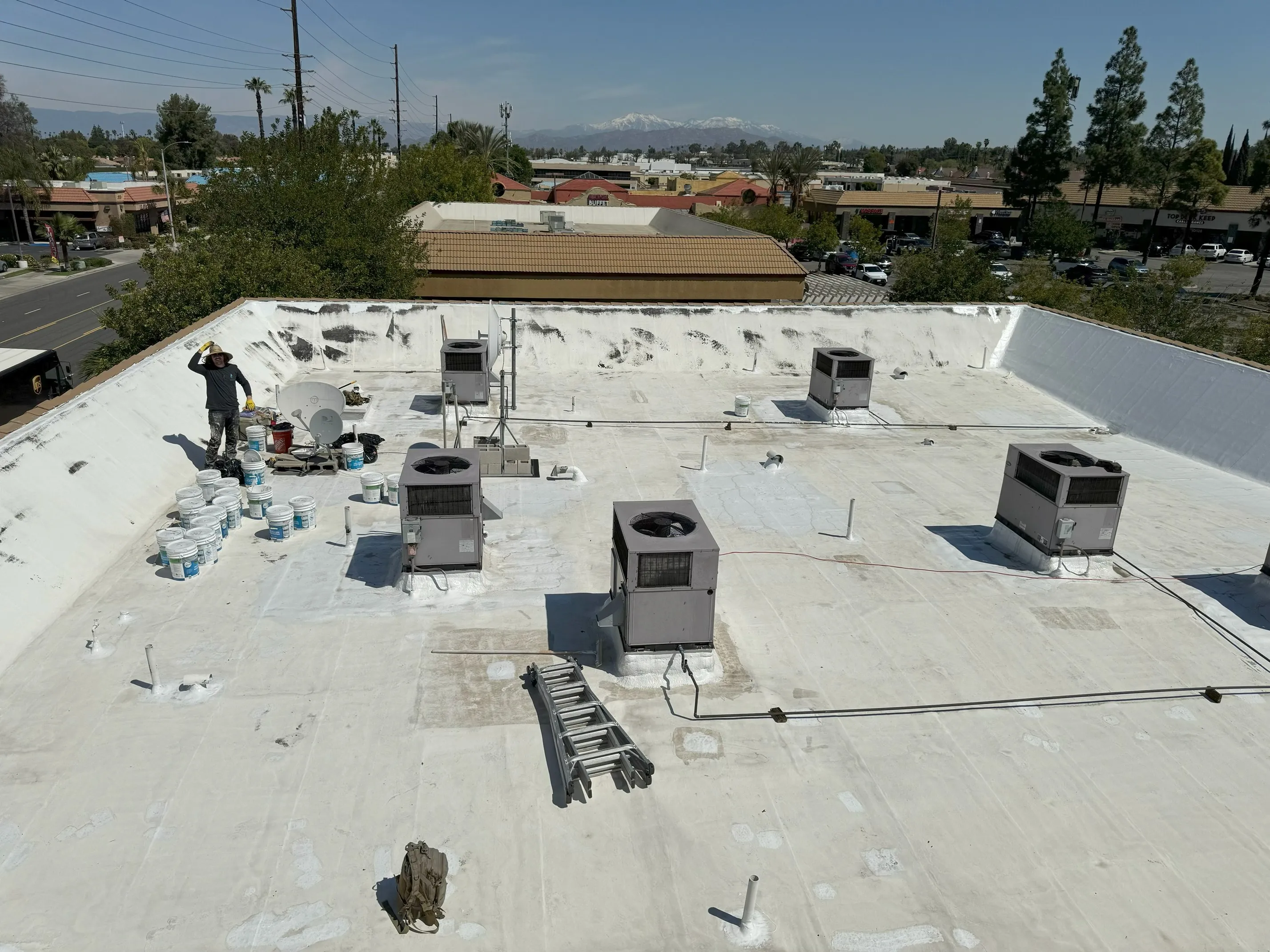
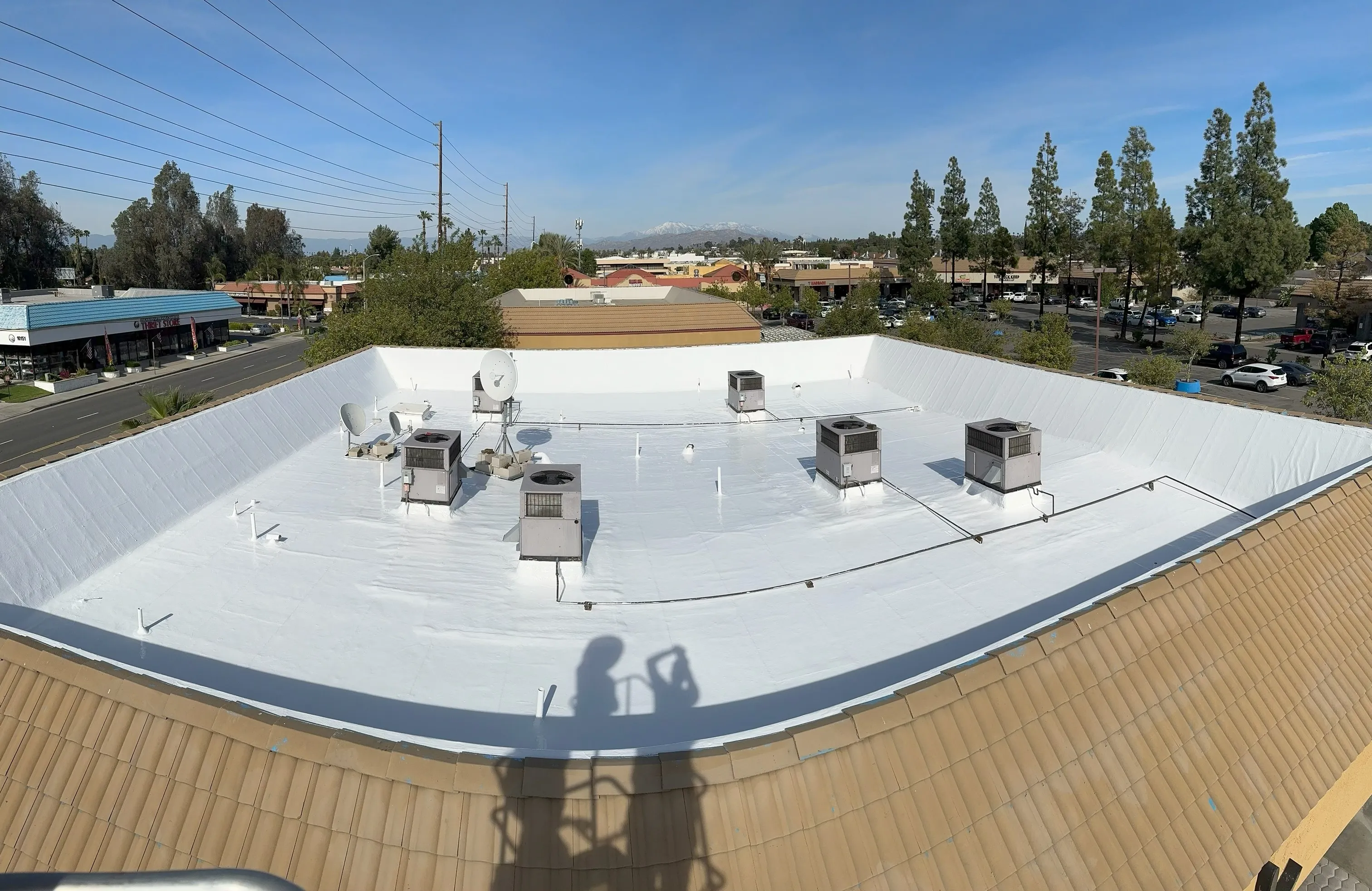
A completed silicone restoration
A commercial strip-center roof with rooftop HVAC — the kind of roof this system is built for. Same roof, before and after.
First question: is the roof actually a candidate?
Restoration is not a universal answer, and a contractor who tells you every roof can be coated is selling material rather than solving a problem. A roof is a candidate when the deck is structurally sound, the insulation is dry, the existing membrane is still adhered and intact enough to carry a coating, and the roof drains.
What we confirm before we will write a system
- Drainage. No single area of standing water greater than 100 sq ft and more than half an inch deep, 24 hours after rain. That is the manufacturer's own threshold. Fail it and drainage gets corrected first — added drains, crickets, tapered insulation — or the roof goes to replacement.
- Dry insulation. Wet insulation does not dry out under a coating; it gets sealed in. Areas over 500 sq ft of wet insulation are cut out and replaced with identical material. Smaller areas with moderate moisture content can be handled with a moisture relief vent.
- Adhesion. Adhesion tests are pulled on the actual substrate before we write a system. If the coating will not bond, the answer is a different primer or a different scope — decided by test, not by assumption.
- Sheet metal and penetrations. Edge metal, counterflashing, curbs, and drains have to be serviceable or they get repaired or replaced as part of the scope. A coating does not fix failed sheet metal.
- Building use. Silicone coatings have a moderate rate of water vapor transmission and are not recommended over cold storage or cryogenic structures, where constant vapor drive can accumulate moisture in the deck and insulation. Refrigerated buildings need an assembly designed for that condition. This matters in Kern County, where a packing house and its cold rooms often sit under one continuous roof.
If the roof fails those tests we will say so and price the replacement instead. See roof coating vs. replacement for how we work that decision.
Specification
The coating we install
Progressive Materials Pro-EcoSil HS 3200 Series — a one-component, moisture-curing, solvent-free high-solids silicone. Published properties from the manufacturer's technical product data:
| Solids content by weight (ASTM D2369) | 92% (+/- 3%) |
|---|---|
| Volatile organic compounds | Under 50 g/L |
| Tensile strength (ASTM D412) | 247 psi |
| Elongation at break, 75F (ASTM D412) | 237% |
| Water vapor permeance at 20 mils (ASTM E96) | 10.7 perms |
| Durometer hardness, Shore A (ASTM D2240) | 37 |
| Temperature stability range | -35F to 212F |
| Accelerated weathering, 5,000 hr QUV (ASTM G154) | No degradation |
| Flame spread (ASTM E108 / UL 790) | Class A |
| Initial solar reflectance, white (ASTM C1549) | 0.89 |
| Initial thermal emittance, white (ASTM C1371) | 0.90 |
| Solar Reflectance Index, white | 113 |
| Tack-free time | 1 to 2 hours |
| Cure time | 1 to 4 hours |
Source: Progressive Materials, Pro-EcoSil HS 3200 Series Technical Product Data. Reflectance, emittance, and SRI values apply to HS 3201 white. A project submittal package includes the current data sheet and SDS.
Why those particular numbers matter
Under 50 g/L VOC
Solvent-free chemistry. Solvent-borne silicones can run several hundred grams per liter, which is a real constraint in the South Coast air basin and on occupied buildings where odor reaches tenants through rooftop air intakes.
10.7 perms at 20 mils
Moderate vapor permeance. It is why the system tolerates minor residual substrate moisture, and exactly why it is the wrong choice over cold storage. A perm rating is a design input, not a bragging point.
237% elongation, 37 Shore A
A soft, high-elongation membrane. It moves with a deck that expands and contracts through a wide daily temperature swing instead of splitting at seams and fasteners.
5,000 hours QUV, no degradation
Silicone does not depend on a UV-blocking pigment package the way asphaltics do. This is the property that makes it the right chemistry for a roof in Bakersfield or Ridgecrest.
Warranty
Film thickness determines the warranty term
This is the part of a coating bid most owners never get in writing. The warranty length is not a marketing tier — it is a direct function of how much cured silicone ends up on the roof. Progressive Materials' fully reinforced system specification ties the two together:
| Manufacturer warranty | Minimum cured film thickness |
|---|---|
| 5 years | 15 mils minimum |
| 10 years | 20 mils minimum |
| 15 years | 25 mils minimum |
| 20 years | 30 mils minimum |
Source: Progressive Materials Recommended Design Specification, Fully Reinforced Silicone Roof System 07545, section 3.3. Thickness is over a reinforced base coat. Requirements differ between PM system types and substrates, and the system written for your roof governs.
The warranty Progressive Materials issues on these systems is alabor and material warranty covering leaks caused by silicone material failure, in 5, 10, 15, or 20 year terms. It is issued by the manufacturer, not by us — andonly a Certified Licensed Applicator can obtain one.We hold that certification. What it takes is on theProgressive Materials Certified Licensed Applicatorpage.
On top of the manufacturer warranty, our own workmanship warranty is 5–10 years on labor and workmanship.
At the end of the term the system is renewable. The roof is cleaned and recoated and a new warranty term is issued, at a fraction of the original installation cost. That is the whole economic case for restoration measured over a replacement cycle.
Execution
How the system actually goes on
Coating failures are nearly always preparation failures. Here is the sequence, in the order it happens on the roof.
1. Substrate evaluation
Roof slope and drainage verified. Deck failures and inadequate sheet metal details identified. Drains inspected for performance. Moisture surveyed, so wet areas are known before anything gets sealed. Newly poured concrete has to cure a minimum of 60 days before coating.
2. Cleaning and priming, by substrate
The whole roof is power washed at a minimum of 2,000 psi, and grease contamination is cut with industrial-strength detergent. Primer is not universal; it is selected for what is already on the roof and confirmed by adhesion test:
- EPDM — rinseable EPDM primer at 400 sq ft per gallon, 15-minute dwell, rinsed, then wash and adhesion test.
- Modified bitumen and smooth built-up — asphalt bleed blocker over the entire roof area and flashings at 1 gallon per square, so asphalt does not bleed through the white finish.
- TPO, PVC, Hypalon — single-ply primer at one third of a gallon per 100 sq ft where the adhesion test calls for it.
- Concrete — two-part epoxy primer, required on concrete less than a year old.
- Sprayed polyurethane foam — coated directly once the foam surface is sound and dry; damaged foam is cut out and replaced first.
- Metal — fasteners and seams handled before any field coating.
3. Repairs and details
- Loose and backed-out fasteners replaced; membrane cuts repaired three-course.
- Lap seams encapsulated with roughly 20 mils of silicone about 2 inches wide before the field is coated.
- Stress cracks under a quarter inch bridged with flashing-grade silicone sealant, 1 inch each side. Cracks and expansion joints over a quarter inch get backer rod fully encapsulated, then 24 hours of cure before base coat.
- Penetrations, curbs, and parapets flashed with flashing-grade sealant or three-course coating-fabric-coating, with fabric carried a minimum of 8 inches up parapets.
- Wet insulation over 500 sq ft cut out and replaced, refastened, and the cut detailed with 20 mils of coating, 12-inch polyester fabric, and another 20 mils. Smaller wet areas vented with a moisture relief vent.
- Sheet metal repaired or replaced wherever it will not hold a watertight condition.
4. Base coat and reinforcement
On a fully reinforced system the base coat goes down at 2.0 to 2.25 gallons per square depending on surface texture. 36-inch polyester fleece is embedded into the wet coating and rolled flat with a nap roller — no wrinkles, no fish mouths, 3-inch overlap between rolls — then another 1.5 gallons per square goes over the fleece.
5. Topcoat
HS 3200 over the entire roof surface at the film thickness the warranty term requires. Because the material is solvent-free it can be built past 40 mils in a single coat without blistering. Vertical surfaces usually take multiple passes to hold thickness.
6. Walkways
Traffic pads are part of the system, not an upsell: 25 mils of walkway coating with granules broadcast at 40 lbs per 100 sq ft on general walkways, 40 mils and 60 lbs per 100 sq ft in high-impact areas around mechanical equipment, minimum 30 inches wide. On a roof with rooftop HVAC and a service contractor walking it every month, this is what keeps the membrane intact.
7. Conditions and cure
No application below 35F ambient, and never within 5F of the dew point. Environmental conditions are logged. The surface stays free of traffic for a minimum of 12 hours after application. In practice the Central Valley and Inland Empire application window runs spring through fall, because the substrate has to be dry — which is also why we schedule around your rooftop equipment work rather than the other way around.
8. Manufacturer final inspection
Progressive Materials' own technical personnel inspect the completed installation and issue an inspection report to the owner. Anything that does not comply gets repaired or replaced before the warranty is issued. That is a real gate, and it is why a manufacturer-warranted system is a different product from "we applied a coating."
One thing to know going in: once the system is on, all subsequent roof repairs must be made with silicone products. Asphalt patches and generic mastics do not bond to cured silicone, and using them will cost you the warranty. Tell your HVAC contractor.
Code compliance
Title 24 cool roof compliance: the low-slope path
The 2025 Building Energy Efficiency Standards apply to permits applied for on or after January 1, 2026. For nonresidential low-slope roofs the prescriptive requirement is aged solar reflectance of 0.63 or better and thermal emittance of 0.75 or better, or an SRI of 75 or better.
The requirement is triggered when you replace, recover, or recoat the lesser of 50% of the existing roof area or 2,000 square feet. Owners are often surprised that recoating counts. It does — and for a silicone restoration that is a non-issue rather than an obstacle, because the numbers clear the bar with room:
- Initial solar reflectance, white silicone: 0.89 (threshold is 0.63 aged)
- Initial thermal emittance: 0.90 (threshold is 0.75)
- Published SRI: 113 (threshold is 75)
The value a plan checker cares about is the aged reflectance, not the initial one, because reflectance falls as a roof soils. Compliance is demonstrated with the CRRC-rated three-year aged value for the exact product and color installed, taken from the Cool Roof Rating Council's Rated Product Directory. Progressive Materials silicone coatings are CRRC-rated products.
The documentation a plan checker wants
- CRRC Product ID number for the specific coating and color, from the CRRC Rated Product Directory.
- Aged solar reflectance, thermal emittance, and SRI as listed by CRRC against that product ID.
- Certificate of Compliance (NRCC-ENV) filed at permit application, showing the roofing product proposed.
- Certificate of Installation (NRCI-ENV-01-E), signed by the installing contractor after the work, confirming what went on the roof matches what was permitted.
- Manufacturer product data sheet for the submittal record.
We pull the CRRC listing for the exact product and color and hand you the documentation set with the job. Exceptions exist in the Energy Code — some roofs with high thermal mass, some with existing continuous insulation, and certain building types are treated differently — so applicability gets confirmed against your specific building with the authority having jurisdiction before the scope is fixed. We do not guess at code on your behalf, and neither should anyone else bidding your roof.
Confirm current requirements with the California Energy Commission and your building department. The 2025 code cycle is new and local amendments are common across Los Angeles County.
A code constraint, turned around
A coating is not a second roof layer
Building codes require full tear-off to the deck once a roof carries two or more applications of roof covering. If your building already has an original roof plus a recover, the next re-roof is a mandatory tear-off — the most expensive and most disruptive option on the table, and you are locked into it.
A fluid-applied protective coating is defined in the code as a coating used for roof maintenance or roof repair. Beginning with the 2018 code cycle the model codes state directly that a new protective roof coating need not be counted as an additional roofing layer against that limit, and the reroofing provisions permit applying a coating over an existing covering without tear-off.
Practically: a recover spends your remaining layer, a restoration does not. On a building you intend to hold, that is worth real money at the next cycle. Permit interpretation is local, so we confirm it with your building department as part of scoping.
- No tear-off — the deck is never opened, so the building is never exposed
- No debris — no dumpsters, no chutes, no landfill tonnage crossing your parking field
- Tenants stay open — retail keeps trading, warehouse keeps shipping
- No layer spent — the two-layer clock does not advance
- Renewable — recoat at term end and reissue the warranty
Operating cost
What reflectivity does on a hot-climate building
A dark, aged membrane absorbs most of the sun that hits it. The U.S. Department of Energy notes that conventional roofs can reach 150F or higher on a sunny summer afternoon and that a reflective roof can stay more than 50F cooler. ENERGY STAR estimates reflective roof products can cut peak cooling demand by 10 to 15 percent.
White silicone at 0.89 initial reflectance and 0.90 emittance sits at the top of that range: it reflects most of the incoming shortwave energy and radiates away most of what it does absorb. On a Bakersfield warehouse or an Inland Empire distribution building running rooftop packaged units through a July afternoon, that shows up in two places — the summer demand charge, and the service life of the units themselves, which are pulling return air off a much cooler deck.
We are not going to hand you a savings percentage for your building without knowing your insulation, your HVAC, and how you operate it. Anyone who does is guessing. What we can tell you precisely is the reflectance, the emittance, and the SRI of the membrane going on, which is the input your energy consultant actually needs.
The same property lowers the thermal load on the roof assembly itself. Membrane surface temperature drives thermal cycling, and thermal cycling is what opens seams and backs fasteners out. A cooler roof ages slower.
Where this works
Buildings we restore
Warehouse & distribution
Large single-ply and built-up fields along the 60 corridor through Commerce and City of Industry, and out into the Inland Empire. Restoration keeps the dock doors working while it happens.
Retail centers & strip malls
Multi-tenant roofs with heavy HVAC penetration density. Every curb is a leak path, and three-course flashing detail at curbs is where the job is won or lost.
Industrial & manufacturing
Metal and built-up roofs over operations that cannot stop. No tear-off means no open deck over production equipment.
Agricultural processing & packing
Kern County has enormous flat and low-slope metal roofs over packing houses, hullers, and processing plants that nobody markets coatings to. Note the cold-storage caveat above — the refrigerated part of a plant needs a different assembly than the dry side.
Apartment & HOA flat roofs
Low-slope apartment decks where a tear-off means scaffolding, resident notices, and parking closures. Restoration avoids all three.
Metal roofs
Fasteners and seams get treated first, then the field is coated, which stops the rust and the seam leaks without the cost of a standing-seam retrofit.
What we need to specify your roof
A real coating proposal is a system written for one building. To write one we walk the roof, and it helps if you can bring:
- Roof area, and a roof plan or drainage plan if you have one
- Existing membrane type and approximate age
- Any existing warranty, and who issued it
- Leak history — where, how often, what has been patched
- Any prior recover, and how many layers are on the deck
- Rooftop equipment, and who services it
- Whether the building is occupied, and any operational blackout dates
What comes back is a written scope with the substrate preparation, the primer, the repairs, the film thickness, the warranty term it carries, and the documentation set. Not a square-foot number on a letterhead.
Why call Green Coast
- Progressive Materials Certified Licensed Applicator since 2024 - only a CLA can obtain the manufacturer warranty.
- Two CSLB classifications - C-39 (Roofing) and B (General Building), in business since 2019.
- 5–10 years on labor and workmanship, on top of the manufacturer warranty on the coating.
- California license #1052777 - licensed, bonded, and insured. Verify it at cslb.ca.gov.
Where we work
Commercial coating and restoration across Los Angeles County and Kern County, plus Orange, San Bernardino, and Riverside counties. See the full service area.
Questions we get from property managers
How thick is the coating actually applied?
Cured film thickness is set by the warranty term you buy, not by preference. Progressive Materials' fully reinforced system specification calls for a minimum of 15 mils for a 5-year warranty, 20 mils for 10 years, 25 mils for 15 years, and 30 mils for 20 years, applied over a reinforced base coat. Material quantity is calculated from that target and from the surface texture of the substrate, and it is verifiable on the job with a wet film gauge.
Will silicone hold up over standing water?
Cured silicone is not damaged by immersion the way asphaltic and most acrylic coatings are, which is why it is the normal choice on roofs that hold water. That is not a license to coat a pond. The manufacturer specification requires that no single area of standing water greater than 100 square feet and more than half an inch deep remain 24 hours after rain. Where drainage is worse than that, drainage gets corrected first or the roof is not a restoration candidate.
Does a coating count against California roof layer limits?
No. Building codes require full tear-off once a roof carries two or more applications of roof covering. A fluid-applied protective coating is defined in the code as roof maintenance or repair, and beginning with the 2018 code cycle the model codes state explicitly that a new protective coating need not be counted as an additional roofing layer. A recover adds a layer and can force the next job to be a tear-off; a coating does not. Confirm the interpretation with your building department before scoping the job, since permit practice is local.
Does coating a roof trigger Title 24?
It can. Under the 2025 Energy Code the nonresidential cool roof requirement is triggered when you replace, recover, or recoat the lesser of 50% of the existing roof area or 2,000 square feet. The relevant point is that this is not an obstacle for silicone. The low-slope prescriptive threshold is aged solar reflectance of 0.63 with thermal emittance of 0.75, or an SRI of 75. White silicone is well above that.
How long is the building disrupted?
There is no tear-off, so there is no open deck, no debris chute, no dumpster rotation, and no day where the building is exposed. Tenants stay open. The roof surface needs to stay clear of traffic for a minimum of 12 hours after application, and rooftop equipment work has to be scheduled around the application window.
What happens when the warranty expires?
A silicone system is renewable. At the end of the warranty period the roof is cleaned and recoated and a new warranty term is issued, at a fraction of the original installation cost. That is the structural argument for restoration: it turns a roof from a periodic capital replacement into a maintained asset.
Request a roof evaluation
We will walk the roof, test adhesion on the actual substrate, survey for wet insulation, and tell you honestly whether it is a restoration candidate or a replacement. If another licensed contractor has already bid it like for like, we will match the price.
Green Coast Builders · CA License #1052777 · Licensed, bonded, and insured. Serving Los Angeles, Commerce, City of Industry, Anaheim, San Bernardino, Riverside, Bakersfield, and Ridgecrest.