Residential roofing · Replacement
Reroofing and roof replacement
A roof replacement is mostly invisible work. What you can see afterwards is the covering; what determines whether it lasts is the deck, the underlayment, and the flashings that go in underneath it. This page is about the parts a bid does not always spell out.
- CA Licence #1052777
- We price match like-for-like bids
- 5–10 years on labor and workmanship
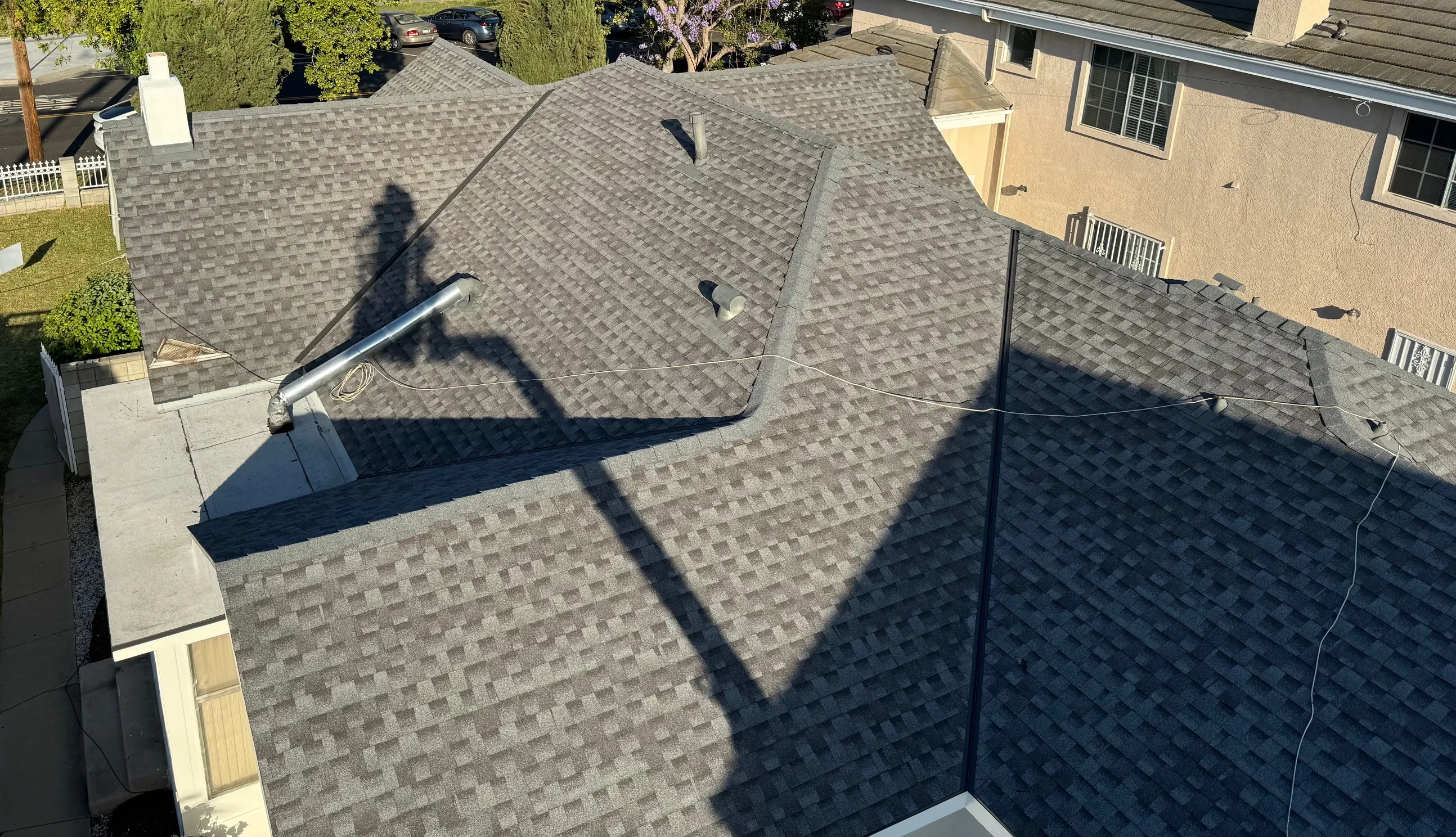
Completed shingle roof replacement - Monterey Park, CA
What a full reroof gets you
Why replacement is worth doing right
A deck someone actually looked at
Tear-off means every square foot of sheathing gets inspected, not assumed sound.
New flashings, no exceptions
Valley metal, counterflashing, and pipe jacks replaced - the details that make a "new roof" leak in year three when reused.
A named material and spec
The underlayment product, the covering, and the deck allowance are stated in writing so bids can actually be compared.
Manufacturer plus workmanship coverage
Manufacturer's warranty on shingles, including lifetime options, and our own 5–10 years on labor and workmanship on top of it.
What a full reroof includes
- Protection and setup. Ground protection, plants and AC units covered, dumpster placed where it will not wreck your driveway.
- Tear-off to the deck. Everything comes off, including the old fasteners. Old nails left in the deck telegraph through new material and become the next set of leaks.
- Deck inspection and repair. Soft, delaminated, or rotted sheathing is replaced. On older homes we also look for spaced or skip sheathing, which has to be sheeted over with solid decking before modern underlayment and fasteners will perform as intended.
- Underlayment. Specified for the covering and the slope. On tile at slopes between 2½:12 and 4:12, code calls for a double underlayment application. Self-adhered membrane at valleys and vulnerable transitions is cheap insurance and we spell out where it goes.
- Edge metal and flashings - all new. Drip edge, valley metal, headwall and sidewall flashing, kick-outs, pipe jacks, chimney counterflashing, skylight curbs. Reusing old flashing under a new roof is the most common way a "new roof" leaks in year three.
- Ventilation. Intake at the eaves and exhaust at the ridge, balanced. Under-ventilated attics cook the underlayment from below and shorten the life of everything above them - a real issue in both a Bakersfield summer and an inland LA one.
- The covering. Installed to the manufacturer's specification, because that specification is the condition of the warranty.
- Cleanup and inspection. Debris hauled, magnet sweep of the drive, lawn and gutters, city inspection scheduled, and a walkthrough with photos of the work that is now buried.
Choosing the covering
Architectural shingle
The default for good reasons: strong price-to-life ratio, wide color selection, straightforward to repair later, and manufacturer warranties that include lifetime options. In a hot, high-UV climate the things that matter are the shingle line you choose, proper fastening, and attic ventilation - a well-ventilated shingle roof outlives a poorly ventilated one by years.
Clay and concrete tile
The right material for a lot of Southern California architecture, and it lasts a very long time - 40 to 50 years for concrete, 50 to 75 or more for clay. The catch is that the tile outlives the underlayment beneath it by decades, so a tile roof needs an underlayment replacement partway through its life. If your existing tile is sound, you may not need a replacement at all - alift-and-relayreuses the tile you already own. Tile is also heavy; converting a shingle roof to standard-weight tile is a structural question, not just a roofing one.
Standing-seam and panel metal
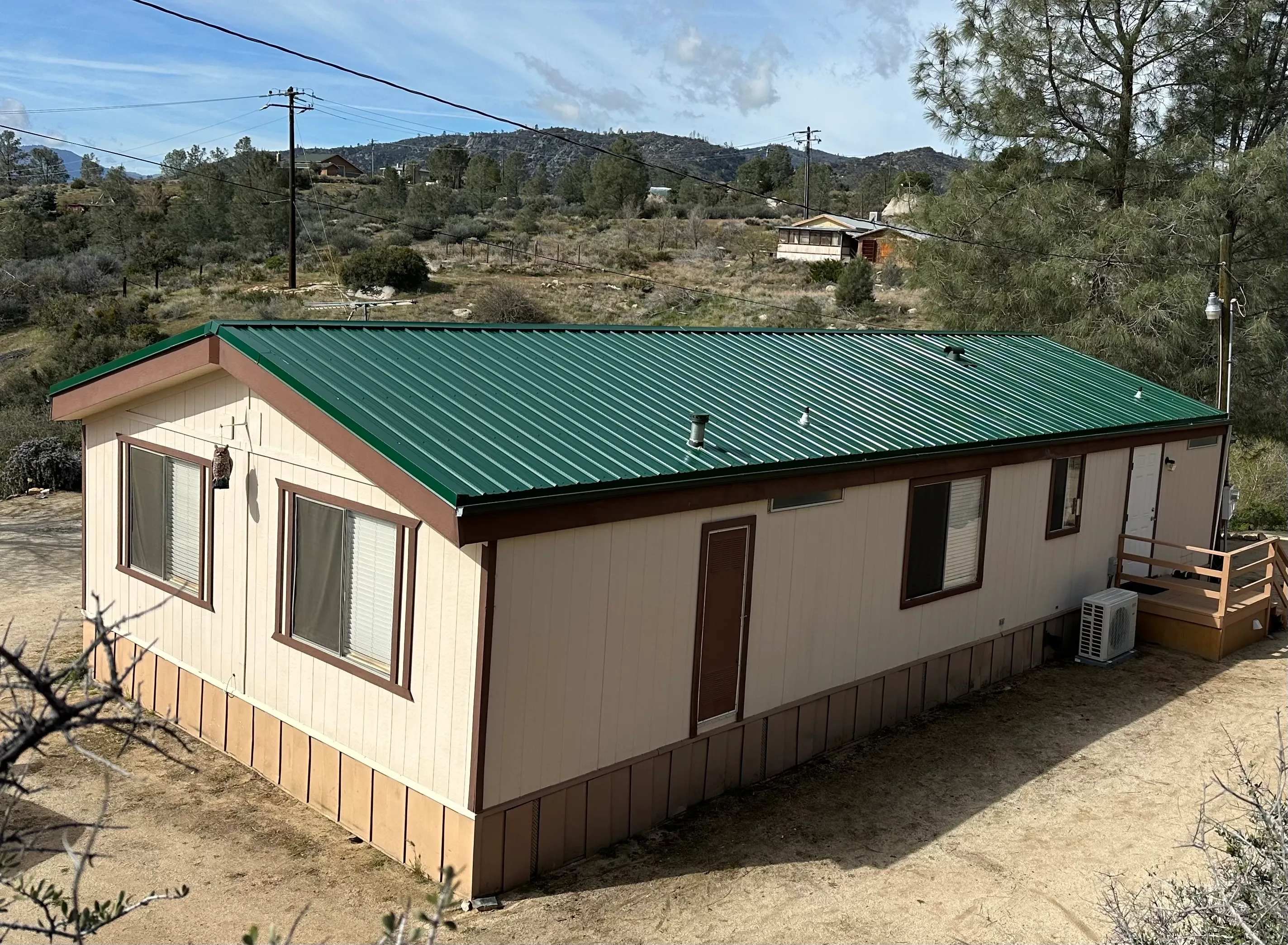
Long service life, excellent in wind, and a strong fit for manufactured and mobile homes and for rural and foothill properties. Panel profile, gauge, finish, and how the transitions and fasteners are detailed matter far more than the metal itself.
Low-slope sections
Almost every house has one somewhere - a porch, an addition, a flat-roofed wing. These need a low-slope system, not shingles laid at an angle they were never rated for. Where a residential flat area is large enough and the substrate is sound, a silicone restoration system can be the better answer than a tear-off. We are aProgressive Materials Certified Licensed Applicator, which means we can issue the manufacturer warranty on that system ourselves - only certified applicators can.
Layers, code, and cool roof rules
California limits you to two roof layers
The California Residential Code caps a structure at two roof coverings at a time. If your house already has two, the next roof is a tear-off - there is no choice to make. A recover over a single existing layer is permitted only where the existing roof and deck are sound and the new covering's manufacturer approves that installation.
Our position on overlays is straightforward: they are occasionally defensible and usually a false economy. You save the tear-off, and in exchange nobody looks at the deck, the roof carries more weight, the old surface shows through the new one, and the next roof is guaranteed to be a full tear-off anyway. On tile the question does not arise - nothing gets installed over a tile profile.
Title 24 2025 cool roof requirements
The 2025 California Energy Code applies to permits applied for on or afterJanuary 1, 2026. For alterations to existing low-rise homes, the prescriptive steep-slope requirement is anaged solar reflectance of 0.20 and thermal emittance of 0.75, or an SRI of 16, triggered when more than 50% of the roof or more than 1,000 square feet - whichever is less - is replaced or recovered. Low-slope requirements are considerably higher.
Two practical notes. First, the prescriptive steep-slope requirement applies in climate zones 10 through 15; the San Gabriel Valley core sits in zone 9, while Bakersfield and the southern San Joaquin Valley are inside the band. Second, the code recognizes equivalent alternatives - including a ceiling insulated to R-38 or better, or a compliant attic radiant barrier - and excludes roof area covered by building-integrated solar. Compliance is documented with Cool Roof Rating Council product labeling.
City of Los Angeles cool roof ordinance and the LADWP rebate
Inside the City of Los Angeles, cool roof requirements apply to residential reroofing citywide - 0.20 aged solar reflectance and 0.75 thermal emittance for steep-slope, 0.63 / 0.75 for low-slope - with exemptions that include roof repair and replacements covering 50% or less of the total roof area.
LADWP's Consumer Rebate Program has paid a base rebate of roughly$0.20 per square foot for qualifying CRRC-rated cool roof products installed over conditioned space, with a higher tier for higher-performing products. Patios, carports, and overhangs are excluded and applications are time-limited after purchase.Confirm current amounts and terms with LADWP directly - we do not administer the program and will not promise you money we cannot pay.
Sources: California Energy Commission 2025 Energy Code (Title 24, Part 6), Cool Roof Rating Council, City of Los Angeles Green Building Code, LADWP Consumer Rebate Program, California Residential Code Chapter 9. Verified August 2026 - confirm current requirements with your building department.
Historic districts and design review
Several cities in our LA-area service area have preservation ordinances that require design review before permit for street-visible exterior work. Replacing like-for-like generally does not trigger it; changing the roofing material generally does. If your home is in a landmark or historic district, confirm the process with your city's planning department before you commit to a material change - it is weeks, not days.
What drives the price
We do not publish square-foot pricing, because the same square footage can differ by a large multiple depending on the roof. These are the real variables:
- Covering - shingle, tile, and metal are different orders of cost, and product lines within each vary widely.
- Size and complexity - valleys, hips, dormers, multiple planes, chimneys, skylights, and every penetration.
- Pitch and access - steep roofs need staging and fall protection; two-story and tight lots cost more to work.
- Deck condition - the biggest unknown, and the reason a real estimate carries a stated repair allowance.
- Layers coming off - tear-off labor and disposal weight, which is substantial on tile.
- Flashing and sheet metal - chimneys and skylights on older homes often need fabrication, not a kit.
- Ventilation upgrades - adding intake or ridge exhaust where the attic never had enough.
- Solar - removing and resetting an existing array is a real line item; sequence it correctly.
- Permits and disposal.
Already have a bid? Bring it. On a like-for-like scope from another licensed contractor we will match it. When you compare bids, look at four things: whether all flashings are new, what the deck repair allowance is, which underlayment is named, and what the workmanship warranty covers. Bids that differ by thousands usually differ on exactly those four lines.
Roof replacement questions
Can I put a new roof over the old one?
Sometimes, on shingle. California limits a structure to two roof coverings at a time, so a house already carrying two layers has to be stripped. Even where an overlay is legal, it hides the deck, adds weight, telegraphs the old surface through the new one, and generally shortens the life of what you just paid for. We will tell you when an overlay is a defensible choice, but a tear-off is what we recommend on most houses.
How long does a roof replacement take?
A straightforward single-family shingle reroof is usually a matter of days. Tile takes longer because every piece is handled individually. Complexity, pitch, access, deck repair, and weather all move the number. We give you a schedule before we start and tell you promptly if deck conditions change it.
Do I need a permit?
Yes - roof replacement is permitted work in essentially every jurisdiction we serve. Fees and inspection requirements differ by city, and unincorporated Los Angeles County is its own process. We pull the permit and handle inspections as part of the job.
Does the new roof have to be a light color?
Not necessarily. California cool roof requirements are expressed as aged solar reflectance, thermal emittance, and SRI values on rated products, not as colors - and the energy code recognizes alternatives such as adequate attic insulation or a compliant radiant barrier. Whether any of it applies depends on your climate zone, your city, and how much of the roof is being replaced. We work it out before writing the estimate.
What warranty do I get?
Two separate things. The materials carry the manufacturer's warranty - shingle lines include lifetime options. Our own labor and workmanship is warranted for 5 to 10 years. Manufacturer warranties generally cover the product, not the installation, which is why the second one matters.
Do I have to move out?
No. A reroof is noisy and the driveway will be occupied, but you can live in the house. Take pictures off walls that share framing with the roof, park on the street, and keep pets inside - falling debris and nail guns are the two things people underestimate.
What happens if you find rot?
Some is normal, particularly at eaves, valleys, and around old penetrations. We carry a deck repair allowance in the estimate, we photograph what we find, and we get your approval before going past it. An estimate with no deck allowance at all is not cheaper - it is just an incomplete number.
Related
- Roof repair - if the roof does not actually need replacing yet
- Tile underlayment replacement - the alternative to replacing sound tile
- Roof inspections - find out how much life is left
- Gutters - the right time to replace them is with the roof
Why call Green Coast for a reroof
- Two CSLB classifications - C-39 (Roofing) and B (General Building) - so deck carpentry and ventilation work stay in-house instead of a second subcontractor.
- We price match like-for-like bids from another licensed contractor.
- California license #1052777, in business since 2019. Verify it at cslb.ca.gov.
What you end up with
A new covering over a deck and underlayment that were actually inspected and repaired, every flashing replaced, a permit pulled and inspected, and two separate warranties in writing - the manufacturer's on materials and ours on the labor.
Where we work
Reroofing across Los Angeles County and Kern County. See the full list of cities we serve.
Get a written estimate
Named materials, a stated deck allowance, and a full flashing scope - so you can actually compare it to anything else you have been quoted.
CA License #1052777. Manufacturer's warranty on shingles, including lifetime options.