Materials · Low-slope and flat roofs
Silicone roof coating: what the material is and where it fits
Most pages selling silicone roof coating describe benefits. This one describes the material - how it cures, why it survives standing water and UV, how it differs from acrylic and urethane, and the four situations where it is the wrong answer. The project specification - film thickness, substrate prep, warranty terms - is on the commercial roof coating page.
- CA Licence #1052777
- We price match like-for-like bids
- 5–10 years on labor and workmanship
Chemistry
Why a silicone membrane behaves differently
Most roofing polymers are built on a carbon backbone. Silicone is not. Its backbone is alternating silicon and oxygen — a siloxane chain — and that single structural difference drives nearly everything an owner cares about.
It does not depend on UV blockers to survive UV
Ultraviolet energy at the earth's surface breaks carbon-carbon bonds. Asphaltic products deal with that by hiding behind granules or aluminum pigment, and acrylics by pigment loading; when the sacrificial layer chalks away, degradation starts. The silicon-oxygen bond is not attacked the same way, which is why silicone coatings are routinely rated through thousands of hours of accelerated weathering without a change in properties. On a roof in Bakersfield or Ridgecrest that is not an abstraction. It is the difference between a coating that is still a membrane in year eight and one that is a chalk deposit.
It cures by reacting with humidity, not by drying
A one-component moisture-curing silicone crosslinks when it meets water vapor in the air. Practically, that means it will cure in conditions that stop a water-based product cold — higher humidity, cooler temperatures, an approaching weather window — because it is not waiting on water to evaporate out of the film. The trade runs the other way in very dry air: at desert humidity the reaction slows and the film stays tacky longer. Neither is a defect. Both are scheduling inputs, and a crew that knows the material plans around them.
It is hydrophobic, so immersion does not soften it
Acrylic coatings cure by losing water and can re-emulsify where water stands. Cured silicone repels water and is not softened by sitting in it. That property is the single reason silicone dominates low-slope restoration: on a flat roof with old tapered insulation, marginal drains, and forty years of settlement, water is going to sit somewhere. A coating that fails where water sits is a coating that fails at the exact place the roof leaks.
It stays soft, and that is on purpose
A cured silicone film runs low on the Shore A hardness scale with very high elongation. A roof deck in the Central Valley can swing more than 50°F between 4 a.m. and 3 p.m. in July, and the assembly moves with it. A hard, brittle membrane telegraphs that movement into splits at seams, curbs, and fastener heads. A soft, high-elongation membrane absorbs it. The cost of that softness is that traffic needs designated, granulated walkways.
Comparison
Silicone vs. acrylic vs. urethane vs. foam
There is no universally best coating chemistry. There is a right one for a given roof, climate, and drainage condition. Here is the honest version.
| Chemistry | Standard spec | Cure | Standing water | UV | Watch out for |
|---|---|---|---|---|---|
| Silicone (polysiloxane) | ASTM D6694 | Moisture cure — reacts with humidity in the air | Not damaged by immersion; the standard choice where water sits | Backbone is inherently UV stable; does not rely on a pigment package | Dirt pickup lowers reflectance over time; surface is slick when wet; future recoats must be silicone |
| Acrylic (water-based) | ASTM D6083 | Evaporative — water has to leave the film | Can soften and re-emulsify under standing water | Good, with reflectance loss from chalking and dirt over years | Needs a dependable dry, warm application window; not for roofs that pond |
| Polyurethane | Varies by product | Moisture cure | Generally tolerant; usually specified as a two-coat base/top system | Aromatic base coats need an aliphatic topcoat for UV | Chosen mainly for impact and traffic resistance, at higher cost and VOC |
| Sprayed polyurethane foam + coating | Foam and coating specified separately | Foam is applied in place, then coated | Foam can be sloped to correct drainage — a coating alone cannot | Foam has no UV resistance at all; the coating is what protects it | A different scope from restoration: it adds thickness, insulation, and slope |
ASTM designations shown are the standard specifications for these coating types. California Energy Code Section 110.8(i) names ASTM C836, D3468, D6083, and D6694 as the performance benchmarks a liquid applied roof coating may be shown to meet. Individual product properties vary widely within a chemistry — the product data sheet governs, not the category.
The short version for a hot, dry climate
If the roof holds water
Silicone. Acrylic is the cheaper material and it is a legitimate product on a roof that drains cleanly, but ponding is the line it does not cross.
If the roof needs slope or insulation
A coating cannot add either. Sprayed polyurethane foam can add both and then be coated. That is a different, heavier scope — and a different conversation about roof height at curbs and drains.
If the substrate has failed
No coating. Seecoating vs. replacementfor how that call gets made and what it costs either way.
California requirement
The code has an opinion about coating thickness
Owners are surprised to learn that California does not treat a roof coating as a cosmetic product. Under Energy Code Section 110.8(i), a liquid applied roof coating used as the top surface of a low-sloped roof has to be applied across the entire roof surfaceat the dry mil thickness or coverage rate the manufacturer recommends for that substrate, and has to meet the minimum performance requirements of Table 110.8-C or of ASTM C836, D3468, D6083, or D6694.
That is the practical answer to "how thick should it be." The manufacturer's published rate for your substrate is the enforceable number, and a bid that does not state it is a bid you cannot verify on the roof or defend at inspection.
Table 110.8-C sets floors for elongation, low-temperature flexibility, tensile strength, performance after accelerated weathering, and permeance. Ask any coating bidder which of those the product meets and how it was demonstrated.
- Applied across the entire roof — not just the visible field
- Manufacturer dry mil thickness — per substrate, not per preference
- Table 110.8-C or an ASTM specification — documented, not asserted
- Aged reflectance, CRRC rated — the value a plan checker uses
- Certificate of installation — signed after the work
Verify current requirements against the Energy Code edition in force for your permit and with your building department. The 2025 standards apply to permits applied for on or after January 1, 2026.
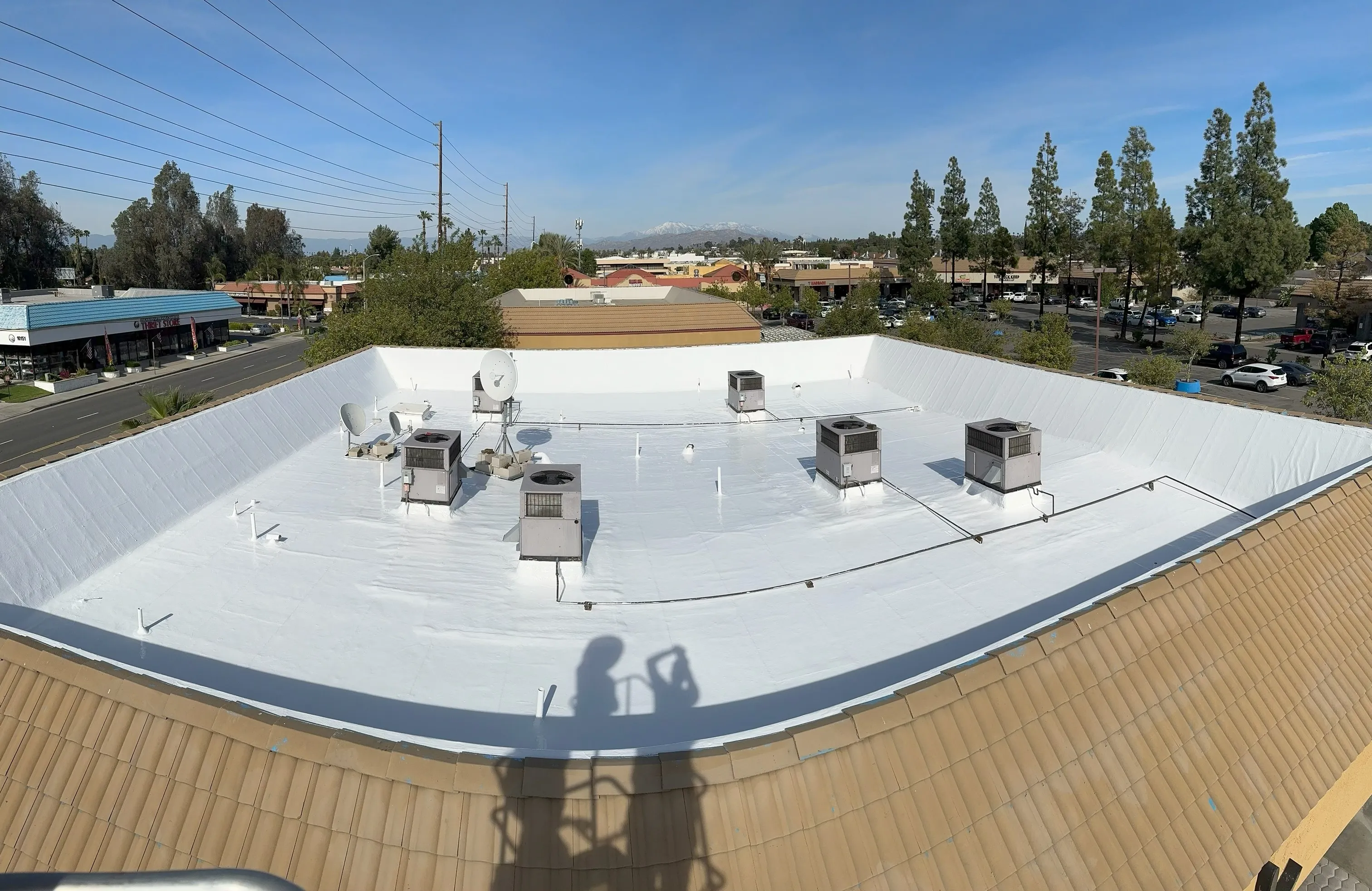
Limits
Where silicone is the wrong choice
A contractor who says every roof can be coated is selling material rather than solving a problem. These are the conditions where we will tell you no.
Cold storage and refrigerated space
Silicone has moderate vapor permeance. Over a constantly refrigerated interior the vapor drive runs the wrong direction all year and moisture accumulates in the deck and insulation. Refrigerated buildings need an assembly designed for that condition. This comes up constantly in Kern County, where a packing house and its cold rooms often share one continuous roof.
A substrate that is already failing
A coating is a membrane, not a structure. Wet insulation, an unadhered or blistered membrane, a deteriorated deck, or failed sheet metal all have to be corrected first. Coating over them seals the problem in and buys nothing.
A roof that genuinely ponds
Silicone tolerates standing water; it does not fix drainage. Progressive Materials sets the line at no single area of standing water larger than 100 sq ft and deeper than half an inch 24 hours after rain. Past that, drainage gets corrected or the roof goes to replacement.
Heavy, undisciplined foot traffic
Cured silicone is soft — Shore A hardness in the 30s. That is what lets it move with the deck, and it is also why service traffic needs granulated walkway pads instead of a bare field. On a roof with a dozen rooftop units and a monthly HVAC visit, walkways are part of the system, not an upsell.
There is one more that is less a limit than a commitment: a silicone roof is a silicone roof from then on. Every future repair, every future recoat, every rooftop-unit curb your mechanical contractor touches has to be detailed with silicone products. That is manageable and it is worth it — but it should be a decision you made knowingly.
Reflectance over time
Aged reflectance is the number that matters
A new white silicone roof measures very high initial solar reflectance. It will not stay there. Silicone surfaces hold dirt, and the bulk of the drop happens in roughly the first six to twelve months before largely stabilizing. Anyone quoting you the initial number as if it were permanent is either uninformed or counting on you being uninformed.
California already accounts for this. Title 24 compliance for nonresidential low-slope roofs is written against three-year aged solar reflectance — a minimum of 0.63 aged reflectance with 0.75 thermal emittance, or an SRI of 75 — as rated by the Cool Roof Rating Council for the exact product and color. A quality white silicone clears that with margin even after soiling, which is precisely why it is a comfortable compliance path rather than a marginal one.
The practical management point: a silicone roof can be washed, and washing recovers real reflectance. If cooling load is part of your business case, put a roof wash in the maintenance program rather than assuming the day-one number holds. We build that intomaintenance programs.
What we install
Progressive Materials silicone, installed by a certified applicator
We install Progressive Materials silicone systems. The reason is not brand loyalty — it is that PM publishes a real design specification with substrate-by-substrate primer selection, repair detailing, film thickness tied to warranty term, and a manufacturer inspection before any warranty is issued. That gives an owner something to hold us to.
Progressive Materials warranties run 5 to 20 years and only a Certified Licensed Applicator can obtain one.PM requires a minimum of five years of roofing experience to hold that status. We do. What the credential involves, and why the issuer of a warranty matters more than its length, is on theCertified Licensed Applicator page.
The full published property table — solids, tensile, elongation, permeance, hardness, reflectance, weathering — along with the substrate preparation sequence and the film-thickness-to-warranty table, is on the commercial roof coatingpage. We put the numbers on the website on purpose.
Beyond the certification, we hold both C-39 (Roofing) and B (General Building) CSLB classifications, in business since 2019. What you end up with is a system matched to your actual substrate, applied at the film thickness the warranty term requires, with the manufacturer's own inspection standing behind it.
Commercial coating work across Los Angeles County and Kern County, plus Orange, San Bernardino, and Riverside counties.
Questions engineers and facilities directors ask
What does "100% silicone" or "high solids" actually mean?
Solids content is the percentage of the wet material that stays on the roof after cure — the rest flashes off. It is measured by ASTM D2369 and it is the number that connects gallons purchased to mils installed. A high-solids, solvent-free silicone leaves most of what you buy on the roof and can be built to a heavy film in one pass. Marketing language like "100% silicone" describes the polymer, not the solids, and the two get blurred on purpose. Ask for the ASTM D2369 number and the VOC content, not the adjective.
Does silicone really hold up in standing water?
Cured silicone is hydrophobic and is not damaged by immersion, which is the practical dividing line between silicone and acrylic. Acrylic cures by losing water and can soften or re-emulsify where water sits. That is why silicone is the default chemistry on low-slope roofs with marginal drainage. It still is not a substitute for drains that work.
Why does a white silicone roof get dirty?
Silicone surfaces hold dirt, and most of the reflectance loss happens in the first six to twelve months, after which it largely levels off. This is why California code compliance is judged on aged solar reflectance rather than the initial value, and why the aged number is the one to ask for. The roof can be washed, and washing recovers a meaningful part of it.
Does low humidity in the desert affect the cure?
Yes, and it is worth understanding if your building is in Ridgecrest, Bakersfield, or the high desert. Silicone cures by reacting with moisture in the air, so cure time stretches as relative humidity drops. It still cures — it just takes longer, which affects how the roof is staged, when traffic can go back on it, and how the crew sequences the day. It is a scheduling input, not a defect.
Can I put acrylic over silicone later to save money?
No. Nothing much bonds to cured silicone except silicone. Once a roof is a silicone roof, every future recoat and every future repair is silicone, and asphalt mastic patches by an HVAC tech will not stick and will cost you the warranty. This is a real long-term commitment and any contractor who does not tell you about it before the job is not being straight with you.
Is there a code minimum for coating thickness in California?
There is a code requirement, though not a single universal number. California Energy Code Section 110.8(i) requires a liquid applied roof coating used as the top surface of a low-sloped roof to be applied across the entire roof surface to the dry mil thickness or coverage rate the manufacturer recommends for that substrate, and to meet the minimum performance requirements of Table 110.8-C or of ASTM C836, D3468, D6083, or D6694. In other words, the manufacturer specification is the enforceable thickness, which is exactly why you want that number in your bid.
Request a specification consultation
Tell us the substrate, the roof area, and the drainage condition, and we will tell you whether silicone is the right chemistry for it — including when it is not. If you need a written system with mil thickness and warranty term for a capital request, that is what we produce.
Green Coast Builders · CA License #1052777 · Licensed, bonded, and insured. Commercial work across Los Angeles, Commerce, City of Industry, Anaheim, San Bernardino, Riverside, Bakersfield, and Ridgecrest.