Residential roofing · Maintenance
Roof maintenance and wet-season prep
In both of our markets, essentially all of the rain falls between November and March, and June through September is close to nothing. That gives you an unusually clear maintenance calendar: the work happens in September and October, and the roof is judged in January.
- CA Licence #1052777
- We price match like-for-like bids
- 5–10 years on labor and workmanship
The Southern California rain calendar
Most of the country has roof problems spread across the year. We do not. Kern County gets roughly seven inches of rain annually, essentially all of it November through March. Greater Los Angeles follows the same seasonal shape at a higher total, and much of that total arrives in a handful of atmospheric river events - narrow corridors of Pacific moisture that deliver a large share of coastal Southern California’s annual precipitation in a small number of storms.
Two consequences follow, and they drive everything on this page:
- Damage accumulates invisibly for six months. Sun, UV, and heat cycling degrade sealants, pipe boots, and underlayment all summer, and nothing tests any of it. A roof can be failing from May onward and give you no evidence at all until the first real storm.
- Everyone calls in the same two weeks. When the first atmospheric river arrives, every roofer in the region is triaging active leaks. That is a bad moment to be starting a conversation about your roof, and it is the most expensive moment to buy anything.
| Window | What it is for |
|---|---|
| September - October | The one that matters. Inspection, maintenance service, gutter clearing and sizing, small repairs, and any deferred work you want done before the rain. Dry substrate, calm schedule, no emergency pricing. |
| November - March | The wet season. Leak response, emergency dry-in, and tarping. Permanent repairs generally need a dry roof, so mid-storm work is often a two-visit proposition. |
| April - August | Replacement and reroof season, and the production window for coatings and restoration systems, which need a dry substrate. Also the right time to plan and budget rather than react. |
What to do in September and October
This is the checklist, in roughly the order the items matter. The first group you can do yourself from the ground. The second group is what we do on a service visit.
From the ground, with binoculars
- Look for displaced, slipped, or cracked tile, and for missing or lifted shingle tabs - particularly along ridges and rake edges after a wind event.
- Check every pipe boot you can see. Cracked and cocked rubber pipe jacks are one of the most common leaks in Southern California, because UV kills the rubber long before the roof around it wears out.
- Look at the ridge line for cracked mortar or rocking ridge tiles.
- Look into the valleys. Debris in a valley dams water and pushes it sideways under the covering.
- Check the gutters for plants, sediment, and standing water, and look at the fascia below them for dark staining or peeling paint.
- Look at the roof plane for sag or waviness, which usually means the deck underneath is going.
- Go in the attic with the lights off and look for daylight, then with a flashlight for stains, rusted nail shanks, and wet insulation.
- Trim back branches overhanging the roof. Abrasion in wind, constant shade and moisture, and a steady debris supply into your valleys and gutters all come from the same limb.
- Photograph anything you find. It gives us something to work from before we arrive.
Please do this from the ground. Getting on a roof to check on it is how people get hurt, and on brittle tile it is how a maintenance check becomes a repair.
What a maintenance visit covers
- Clear the roof. Leaf litter and debris out of valleys, off low-slope areas, away from drains and scuppers, and out of the gutters. Most of the water damage we see traces back to water that was blocked rather than water that came through a hole.
- Service every penetration. Pipe jacks, flues, vents, bath fans, satellite and solar attachments. Cracked boots get replaced, not caulked. Sealants at counterflashing and reglets get cut out and redone where they have failed rather than smeared over.
- Check and reseat fasteners. Exposed and backed-out fasteners, particularly on metal roofs and on ridge and rake details.
- Flashing walk. Valleys, headwall and sidewall flashing, kick-outs, chimney counterflashing, and skylight curbs - where the great majority of residential leaks actually begin.
- Tile and shingle spot work. Slipped tiles reset, cracked tiles swapped for matching stock, loose ridge re-bedded, missing shingle tabs replaced.
- Low-slope check. Seams, terminations, edge metal, blisters and splits, drains and scuppers, and evidence of standing water.
- Drainage check. Gutter pitch, hanger condition, downspout capacity, and where the discharge actually ends up. Seegutters.
- Attic look where access allows. Staining, ventilation, and any evidence of past water that the roof surface does not show.
- Written findings with photographs. What we did, what we found, what needs attention now, and what can wait a season. Keep it - a dated record of roof condition is genuinely useful when you sell, and it is what a warranty conversation runs on.
Flat and low-slope roofs: where small problems compound
Almost every house has one somewhere - a porch, an addition, a garage, a flat-roofed mid-century wing. And low-slope roofs behave differently from steep ones in a way that makes maintenance disproportionately valuable.
On a steep roof, gravity forgives a marginal detail. Water is moving, it wants to leave, and it is only in contact with any given point for seconds. On a low-slope roof there is no such margin. Water sits. A minor defect that a 6:12 roof would shrug off becomes a permanent, saturated contact point.
The compounding chain
- Debris blocks drainage. A drain strainer packed with leaf litter, a scupper half-blocked, or a slight low spot filled with sediment.
- Water stands. The industry’s working definition of ponding is water still present 48 hours after rainfall in conditions that would otherwise dry. That is the threshold, and it is a real finding rather than a cosmetic one.
- Standing water accelerates everything. It concentrates dirt and organic growth, it works at seams and laps continuously instead of intermittently, and it magnifies UV exposure on the surface around it.
- A seam or a lap opens. Now water is in the assembly rather than on it.
- The insulation and the deck get wet. This is the expensive stage, and it is invisible from inside for a long time because the water spreads laterally through the assembly before it drips anywhere.
- The wet area holds more water, which deepens the pond.Saturated insulation compresses, the low spot gets lower, and the cycle tightens.
Every step in that chain is cheap to interrupt at the top and expensive at the bottom. Clearing a drain is a few minutes of work. Replacing wet insulation and rotted deck is a project.
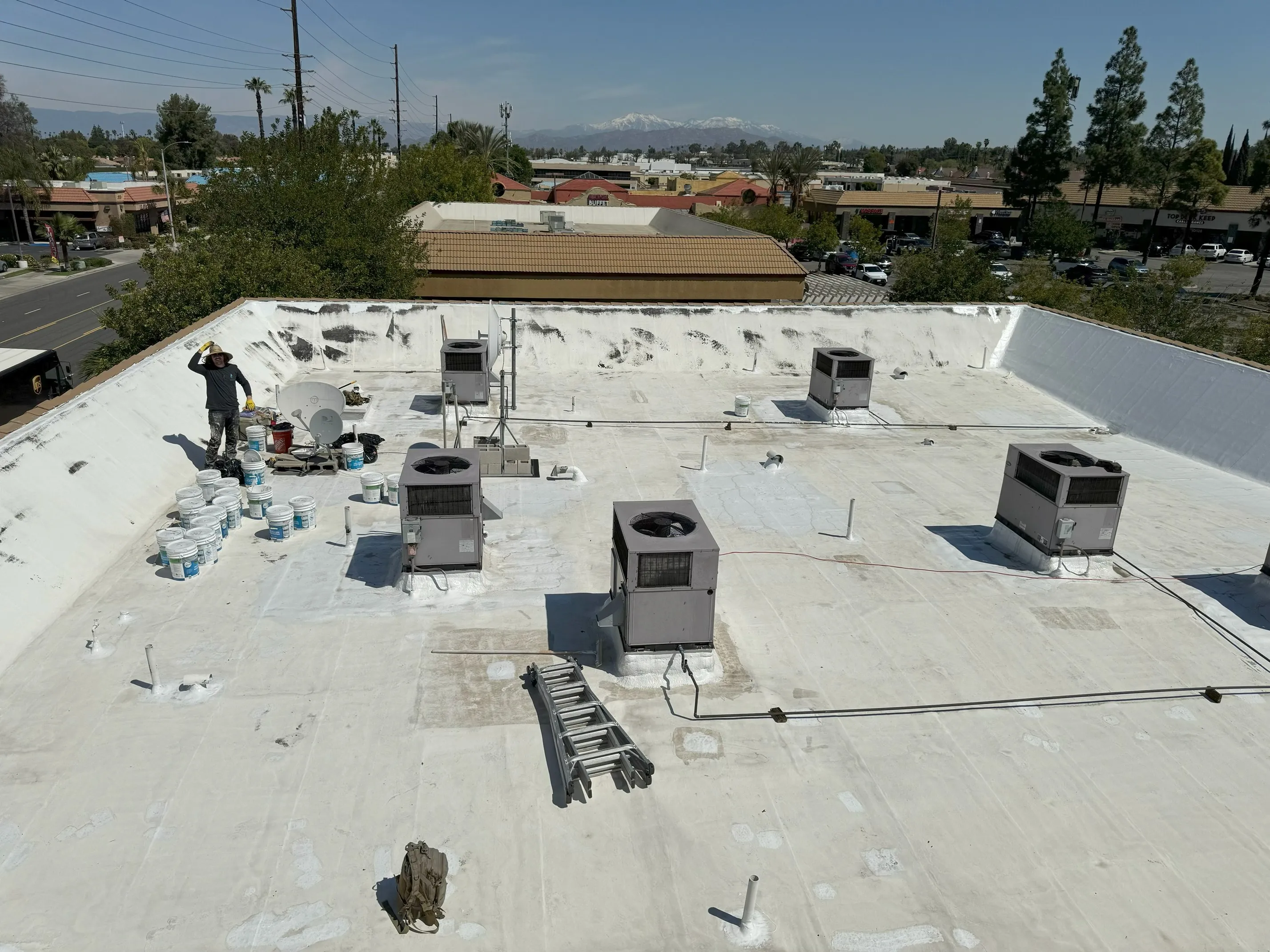
Where a low-slope area is large enough and the substrate is still sound, maintenance eventually gives way to a better question: restore or replace. A silicone restoration system can seal and renew a low-slope roof without a tear-off, and we are aProgressive Materials Certified Licensed Applicator, which means we can issue the manufacturer warranty on that system directly. On a residential porch or addition it is usually overkill; on a large flat wing or a detached structure it sometimes is not.
Why maintenance is worth paying for
It moves the failures forward in time
Sealants, pipe boots, and flashing details fail years before the covering does. Catching them on a dry September afternoon costs a fraction of catching them when they are running into a bedroom ceiling in January.
It keeps a warranty meaningful
Manufacturer and workmanship warranties generally assume the roof is maintained, and generally exclude neglect and the damage that follows from it. A dated maintenance record is what makes that conversation short.
It buys you a real replacement date
Roofs get replaced on emergency timelines because nobody was tracking them. A maintained roof comes with an informed estimate of remaining life, which means you replace it on your schedule and your budget.
It protects what is under the roof
The roof covering is rarely the expensive part of a roof failure. The deck, the insulation, the framing, the ceiling, and the contents underneath are.
It creates a paper trail for a sale
Dated reports with photographs are exactly what a buyer’s agent asks for, and they make aroof certification at sale time a much shorter process.
It is scheduled work, not emergency work
Work booked in October is planned work. The same work in January is competing with every active leak in the region for the same crews.
What maintenance cannot fix
Honest limit: maintenance manages a roof, it does not extend a waterproofing layer past its service life. If the underlayment beneath your tile is thirty years old, no amount of debris clearing changes what is going to happen - seetile underlayment replacement. If a shingle roof is at the end of its run with granules in the downspouts and multiple leaks in unrelated areas, maintenance is renting time at a poor rate. We will tell you when you are in that situation rather than selling you an annual service on a roof that needs replacing.
Roof maintenance questions
How often should a roof be inspected or serviced?
The National Roofing Contractors Association recommends building owners and homeowners have roof systems inspected at least twice a year, in the spring and the fall. In our climate the fall visit is by far the more important of the two, because it is the one that happens before the rain. On a simple, newer, steep-slope roof with no tree cover, once a year in September or October is a defensible schedule. On a flat or low-slope roof, or a roof under heavy trees, twice a year is the right answer.
Is maintenance worth it on a roof that is only a few years old?
Yes, for two reasons that have nothing to do with the covering wearing out. First, the things that fail early are not the shingles or the tile - they are sealants, pipe boots, and debris in valleys, and they fail on new roofs as readily as old ones. Second, manufacturer warranties and workmanship warranties generally assume the roof is being maintained; neglect and consequential damage are common exclusions. Documented maintenance is what keeps a warranty conversation short.
What can I safely check myself?
A great deal, from the ground with binoculars: displaced or slipped tile, missing shingle tabs, a cracked or cocked pipe boot, debris piled in a valley, plants growing in a gutter, staining down the fascia, and daylight or new stains visible in the attic. What we would ask you not to do is get on the roof. Wet tile and composition shingle are extraordinarily slick, brittle tile breaks under foot traffic in ways that create the leak you were trying to avoid, and falls from residential roofs are genuinely serious.
Does maintenance include repairs?
Minor items get handled on the visit - resealing an exposed fastener, clearing a valley or a drain, re-bedding a loose ridge tile, replacing a cracked pipe boot. Anything larger gets photographed, written up, and priced, and you decide. We will not do open-ended work on your roof without telling you first, and we will not invent findings to fill a service call.
Do tile roofs need maintenance?
They need a different kind of it. The tile is durable and mostly looks after itself. What needs attention is everything else: valley metal and the debris that collects in valleys, mortar cracking out of ridge and hip, slipped tiles, and the condition of the underlayment underneath - which is the layer that actually keeps water out and has a much shorter lifespan than the tile. Foot traffic is the main risk, which is why tile maintenance is worth having someone do who works on tile regularly.
Should I have the roof looked at after a Santa Ana wind event?
It is worth a look, yes. Wind damage frequently does not read from the street. A lifted row of shingles along a rake, a course of tile that has slid an inch, a torn pipe boot, or a piece of ridge cap that is gone will not announce itself until it rains. If a wind event happened before the wet season, that is the single best time to check.
Can you maintain a roof you did not install?
Yes, and most of the roofs we service are ones we did not build. We will tell you honestly what we find, including if the answer is that the roof is past the point where maintenance is a good use of your money.
Is roof washing or pressure washing a good idea?
Pressure washing a composition shingle roof strips granules and takes years off it, and on tile it can drive water under the tile and damage mortar. Where moss or heavy organic growth genuinely needs removing, it is a low-pressure and chemistry problem, not a pressure problem. We would rather clear the debris that causes the growth than blast the surface that is holding the roof together.
Related services
- Roof inspections and certifications - the written version, for a sale or your records
- Gutters - the drainage half of wet-season prep
- Roof repair - when maintenance finds something real
- Tile underlayment replacement - when the layer that matters is done
- Silicone restoration - for larger low-slope roofs
Do we sell a maintenance plan?
We offer annual maintenance agreements, and in practice they are mostly sold to commercial buildings — flat and low-slope roofs, where drainage blocks up and small problems compound quickly, are where a scheduled visit earns its money. Annual programmes start at $1,295. Seecommercial roof maintenancefor how those work.
On a house, maintenance is usually better handled as a one-off visit before the wet season rather than a standing agreement. Call 661-578-3346 and we will tell you honestly which one your roof actually needs.
A maintenance agreement is not a warranty. It is scheduled upkeep that catches problems early. It does not guarantee the roof against failure, and we would rather be clear about that up front.
Why call Green Coast for maintenance
- Two CSLB classifications - C-39 (Roofing) and B (General Building), in business since 2019.
- Written findings with photos on every visit, not a verbal summary at the truck.
- California license #1052777 - licensed, bonded, and insured. Verify it at cslb.ca.gov.
What you end up with
A cleared, serviced roof going into the wet season, a dated written record you can point to if a warranty question ever comes up, and a straight answer about how much life the roof has left.
Where we work
Maintenance visits across Los Angeles County and Kern County. See the full list of cities we serve.
Get on the schedule before the rain
September and October fill up, and they fill up with people who remembered last winter. Tell us the roof type and roughly how old it is and we will tell you what a visit involves.
Serving greater Los Angeles, the San Gabriel Valley, and Kern County. CA License #1052777.